The platform
One UNS. From machine signals to business decisions.
We connect equipment and software you already run through one unified namespace — a UNS. Each event gains a consistent identity and its operational context, so applications and people work from the same information.

Start with one event
A stopped machine becomes a shared business event.
Read the state the controller already reports. Attach the site, the line, the machine and the order running at the time. Then let operations investigate the stop and planning identify the affected run — from the same event, at the same moment, without anybody re-typing it.
The information gap
The filler stopped. Which order is affected?
The machine screen shows the stop. Planning still has to work out which run it belongs to, and the operator has to explain it again. The event exists; the shared context does not.
- On the lineLine 1 · FillerStopped at 14:07
- What happens nextCall, check,type it in again
- In the officeOrder 1042Status needs checking
A machine event becomes somebody's manual reconciliation task.
With a UNS
Connect the event to the order. Give everyone the same answer.
Read the controller that already knows, attach the site, line, machine and the order running at the time, then share that one event with the applications and the people who need it.
- On the lineLine 1 · FillerStopped at 14:07
- Shared contextSite · line · machineand the live order
- In the officeOrder 1042Filler stopped · investigate
The same event, in front of everybody who has to act on it.
The controller already on the machine supplies the event. The UNS adds the asset context. The production application relates it to the run. Your business system supplies the order.
An illustrative scenario, not a measured incident. The machine, the time and the order number are written to be followed.
The UNS
Give information a location, a meaning and an owner.
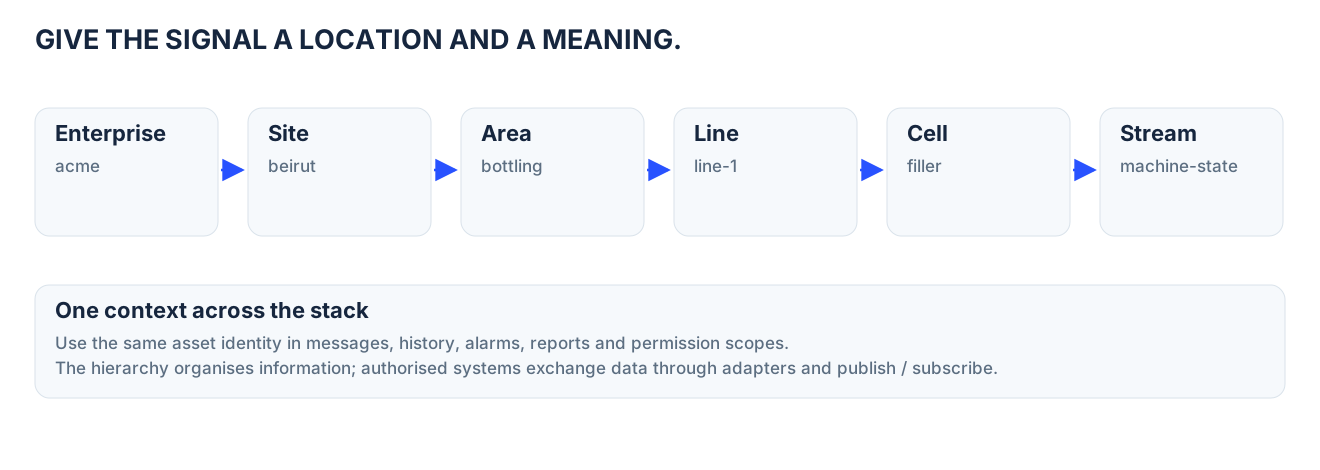
Every value carries a full address: the business, the site, the area, the line, the machine, and what kind of reading it is. That structure follows the standard the industry already uses to describe a plant, and it is what the literature calls a unified namespace.
It matters because the address is stable. A chart, an alert, a report and an export all point at the same address — so renaming a line renames it everywhere, and adding a machine does not mean rebuilding a dashboard.
site / packing-hall / filling-line-2 / capper / power
 DRAWN
DRAWNThe hierarchy is ISA-95, the standard for describing a plant. Messages move as MQTT with Sparkplug B payloads, which means every value arrives with its own type, its own timestamp and a description of what the device can produce — so a system that connects later knows what exists without being told. The namespace is what gives those messages their context: a broker moves them, a historian stores them, and neither is the other.
What runs on it
Three application domains, on one foundation.
Production
MES
Understand the run.
- Production orders and the runs against them
- Downtime, with the reason attached to it
- Quality events, where the line reports them
- Performance and OEE, inside the same application
A useful performance figure depends on the inputs behind it — valid running time, an agreed ideal rate and a trustworthy good count. Those are agreed during scoping rather than assumed.
Energy
EMS
Understand energy in context.
- Consumption by area, line and machine
- Which source carried it: grid, generator, solar, battery
- Trends over a period you choose
- Cost attributed to the work that caused it
Energy is one application on the UNS, not the product. What makes it worth more here than elsewhere is that it sits beside what the plant was making at the time.
Buildings
BMS
Bring building operations into the picture.
- Environmental readings from the spaces that matter
- Scheduled control of the equipment that accepts it
- The same addresses as everything else on site
Which inputs and outputs are actually required is identified during the survey — a building system is mostly a question of what is already wired.
Business systems
Connect plans to actuals.
Exchange agreed orders, products and production events with the business systems you already run. Odoo and ERPNext are current integration paths; anything else is scoped through its interface — an API, a signed webhook, a file drop or a suitable adapter.
These are destinations we connect to, not applications we supply. A full business system or warehouse system is not a sol4.o module and this site will not present one as though it were.
Reading and writing
It reads, and where it is safe, it writes.
The same connection that reads a breaker can switch it, and the same connection that reads a controller can change a setpoint — on equipment that supports it, and where the customer has asked for it. Control is off by default, scoped per device, and every command is recorded against the person who issued it.
A failed reading is never a number.
How we deliver it
A practical path from assessment to everyday use.
Start with a business question and the systems you already have. We assess the signals available, agree a demonstration, and scope the integration, software and training needed to make the result useful.
- 01AssessA map of the systems, the signals available and the question worth answering first.
- 02DemonstrateA working demonstration on your own data, not a slide of somebody else's.
- 03ProveOne agreed workflow, with a baseline, an owner and a result.
- 04ExpandA scope for the next machines and applications on the same foundation.
- 05GovernDocumented data ownership, access and a change process, and the team trained on it.
A demonstration and a commissioned project are different things, and we will say which one we are quoting. How long any of it takes depends on the site, and we will not put a number on that before walking it.
The first demonstration
See your own readings in the software.
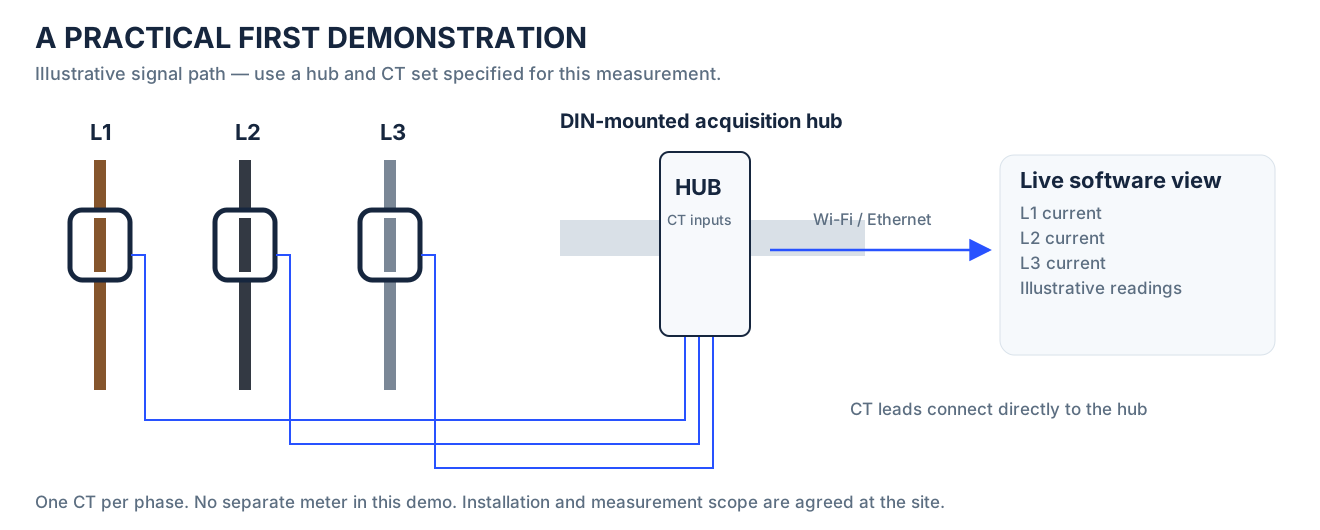
A reusable demonstration kit makes acquisition concrete. For a three-phase current example, one current transformer goes around each separate phase conductor and connects to a compatible acquisition hub. The live view shows the phase readings with their shared context already attached.
 DRAWN
DRAWNA conceptual signal path, not an installation instruction. Current on its own does not establish billed energy or power factor — what is actually being measured is scoped before anything is quoted.
Now connect the rest of the plant.
Reuse the controllers, machine interfaces, site systems and servers already there to add state, counts and process information. The same UNS carries production workflows and business-system integration.


Where it runs
Cloud visibility. Local options where the site needs them.
The deployment design decides which services keep working when the connection does not — so it is a decision, not a default.
Cloud
Shared access, remote visibility and a view across several sites.
A cloud-only deployment depends on the site's uplink for those services.
Cloud and a local server
On-site views, local history, manual control and time-based schedules, alongside the cloud services.
Rules and notifications that run in the cloud still need the cloud to run them.
Local project
A separately scoped local implementation on the supported local runtime.
The features, the access model, maintenance and how it synchronises are specified per project.
We will not tell you that everything keeps running when the internet does not. Which parts do is a design decision for your site, and it is written down before anybody installs anything.
Implementation example
What has actually been built.
- The question
- An estate running several buildings on mixed supply wanted to know where its electricity was going, by area rather than as one monthly bill.
- Equipment and scope
- Existing switchgear, added measurement where nothing was measuring, edge acquisition on site, and the UNS above it.
- What was connected
- Metering and edge devices reporting into one addressed model, with history kept and readable per area.
- What was observed
- Consumption became attributable to areas rather than to the site as a whole, and the difference between what was measured and what was billed became visible.
- What is next
- The same foundation carries a production workflow without a second installation. That is the work being scoped now.
One production estate, anonymised at the customer's discretion. The energy working — the method, the window, the instruments and what it does not establish — is published in full in the study.
Bring one workflow. We will map the path from signal to decision.
You do not need a plan for the whole plant. One question, one line, one thing you want to stop guessing about is enough to scope a first demonstration.